3GRAMS: from a self-hosted store to a Shopify operation that ran itself.
Seven years designing, manufacturing, and selling a line of precision consumer accessories direct to customers. $1.4M+ in lifetime sales, a WooCommerce-to-Shopify migration that removed the store's single biggest failure point, and the growth and operations systems that let a very small team run like a bigger one.
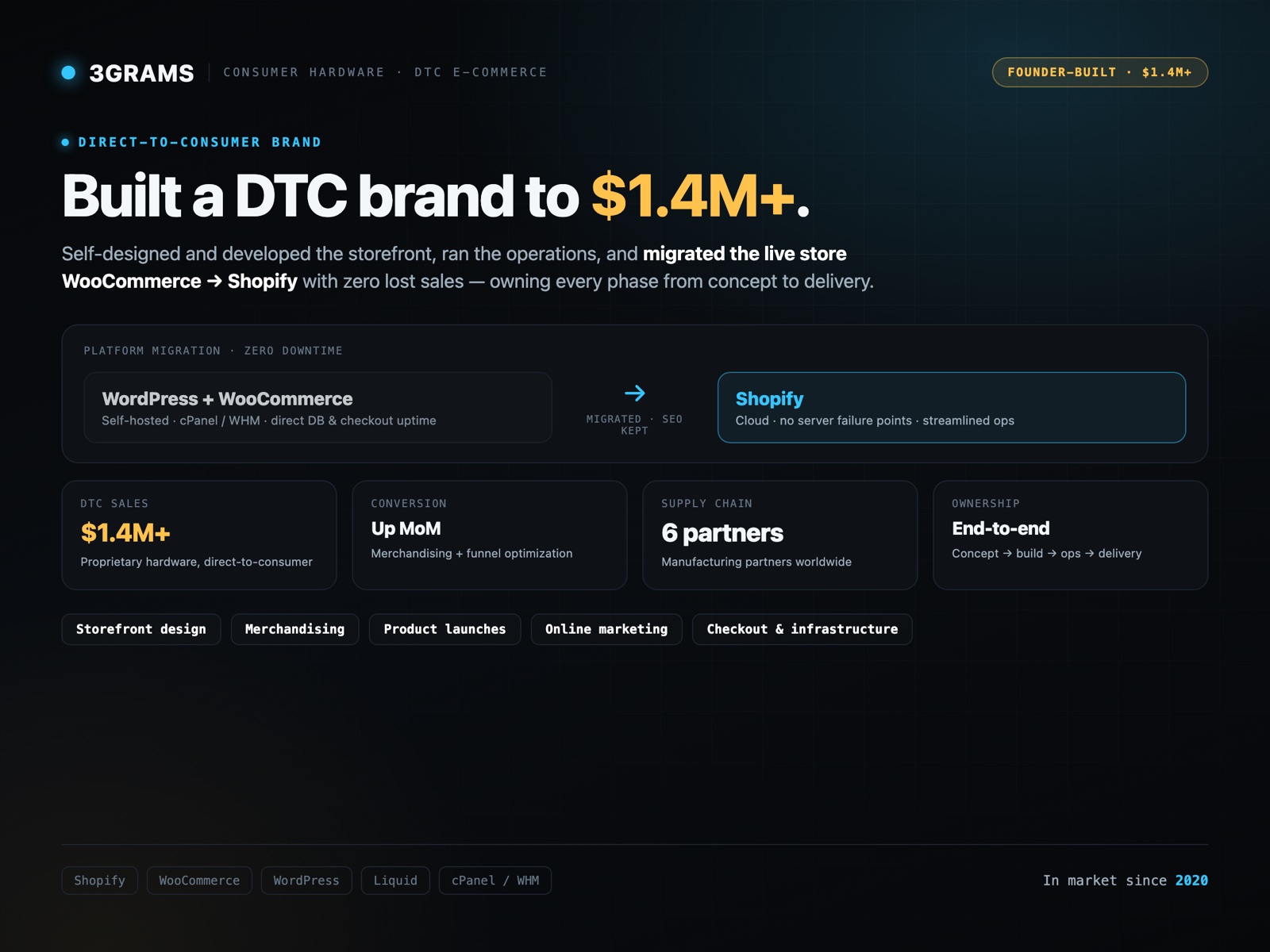
A hardware brand that sold directly to the people who used it.
3GRAMS made precision ceramic accessories for a consumer hardware category where materials and tolerances matter to the buyer. Products were designed in-house, produced through six manufacturing partners overseas, and sold almost entirely direct to consumer through the brand's own store. The customer was an enthusiast who read spec sheets, compared materials, and came back for the next release.
That shaped every e-commerce decision. The storefront had to explain why a part was different, not just show it. Launches worked best as events. And because the team was small, anything that pulled attention away from product and marketing had a real cost.
The store's biggest conversion problem wasn't the design. It was uptime.
The first store ran on WordPress and WooCommerce on a private server I administered myself: cPanel, WHM, the database, backups. When checkout broke, and it did, the fix was a database restore through phpMyAdmin at whatever hour it happened. Each outage was lost revenue twice over: the orders that didn't complete, and the founder hours spent on infrastructure instead of the next product.
Checkout outages tied to the server and plugin stack. Plugin updates that broke the cart. No managed payments. Every fix required server-level access and my time specifically.
A checkout that never went down, payments and tax handled by the platform, and a storefront I could change without touching a server. Less control, more reliability.
Migrate to Shopify, and treat the migration as a product launch.
The tradeoff was explicit. Shopify meant giving up server control and some customization in exchange for managed checkout, payments, hosting, and an app ecosystem. For a small brand whose revenue depended on checkout working at 11pm on a drop night, reliability won.
- Catalog and customer migration. Products, variants, images, and customer records moved and verified before cut-over.
- Redirect map. Every old WooCommerce URL mapped to its Shopify equivalent so search rankings and inbound links survived.
- Theme rebuilt around the brand. Liquid theme designed in-house: product pages structured around materials and specs, collections organized the way customers actually shopped.
- Launch checklist. Test orders, payment flows, shipping rules, and tax settings signed off before DNS moved. Old server kept warm for a rollback window.
Designing pages for a buyer who reads.
I designed the storefront myself, end to end. The product page was the core design problem: a buyer comparing ceramic grades and tolerances needs the spec story above the fold, the variant choice to be obvious, and the add-to-cart to stay within reach while they read. Collections were built around use and compatibility rather than internal SKU logic.
- Launches as events. Limited runs announced ahead of time, with the storefront and Instagram pointed at a single drop page.
- Merchandising by compatibility. Customers shopped by what they already owned, so navigation followed that.
- Continuous iteration. Page changes were measured against conversion and adjusted monthly rather than redesigned in big bangs.
Instagram was the largest channel, so I built the machine that ran it.
The brand's biggest outlet was Instagram, and content creation was the bottleneck. I built an automation stack on the Meta Graph API that handled content generation, scheduling, analytics, and engagement, managed from a Next.js and TypeScript operations dashboard wired to the Shopify catalog. Products and posts lived in one place; a launch could be planned, scheduled, and tracked without leaving the dashboard.
Everything behind the add-to-cart button.
Sourcing and quality across six overseas manufacturing partners, inventory planning around production lead times, fulfillment, customer service, and the patent design and filing work that protected the product line. The storefront only converts if the product ships on time and arrives as described, so operations were part of the e-commerce job, not separate from it.
I ran the whole thing. Here is what that built, and why I want to do it with a team.
Founders can read as a risk to a hiring manager: used to calling every shot, hard to manage, likely to leave. I understand the concern, so here is the honest version.
- I've been accountable for the number. Not a metric on a dashboard, the actual revenue that paid the manufacturers. That makes me careful with other people's budgets and impatient with work that doesn't move something.
- I respect process because I've paid for skipping it. The WooCommerce years were the cost of moving fast without the right foundation. I don't need to relearn that lesson on someone else's store.
- I've already done this inside a large organization. In 2023 and 2024 I was Lead Product Development Engineer at STIIIZY, reporting to leadership, managing overseas manufacturing partners, and shipping on other people's timelines. I was good at it.
- I document and hand off. Every system I build is written up so someone else can run it. That habit comes from needing the business to work when I wasn't there.
- Solo zero-to-one has a ceiling. The next version of this work, at real scale, with research, analytics, and engineering partners, needs a team. That is what I'm looking for.